We Don’t Need No Flaming Sparky Cars
Live by the mandate, die by the mandate.
[In 2021, Ford] announced a joint venture with SK to build a pair of battery factories, one in Kentucky, the other in Tennessee. BlueOvalSK represented an $11.4 billion investment that would create 11,000 jobs, we were told, and an annual output of 60 GWh from both plants.
Four years later, things look very different. EV subsidies are dead, as is any inclination by the current government to hold automakers accountable for selling too many gas guzzlers. EV-heavy product plans have been thrown out, and designs for new combustion-powered cars are being dusted off and spiffed up. Fewer EVs means a lower need for batteries, and today we saw that in evidence when it emerged that Ford and SK On are ending their battery factory joint venture.
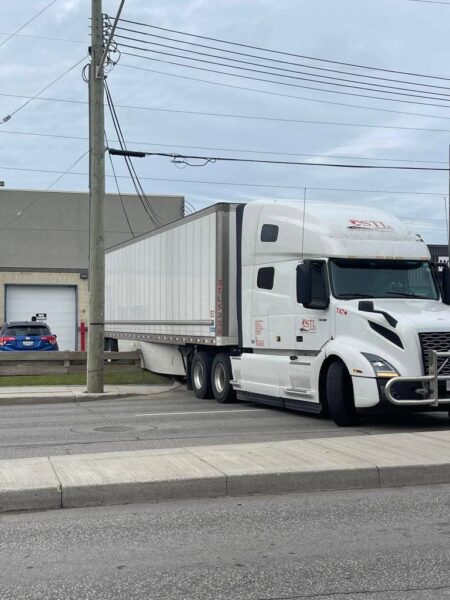
Nites Ov De Rod
Kam Bhullar trucking out of BC. @Kbhullartrkin.
"Honest & Efficient Workpic.twitter.com/BcAdWKdBEl
Our mission at Kam Bhullar Trucking Ltd. is simple: to provide high-quality services for our valued clients. Our team is dedicated to meeting each project's specific requirements.…— Martyupnorth®- Unacceptable Fact Checker (@Martyupnorth_2) December 4, 2025
Note: from 2021
Dead Men Floating
Full video here.
Mustang Diaries
A passenger once asked (as I slowed to wait for cross traffic on a left turn), “Why are you staring in the rear view mirror?”
I replied, “Nothing sharpens your situational awareness like driving without brake lights“.
Square Corners

Yes, it’s real.
Nites Ov De Rod
I considered adding a “language advisory” to this, but decided most of you will do your own launguaging, anyway.
End Of The Road

Pre-orders open now.
Magill, a third-generation trucker who has driven the ice roads of the Great White North, the deserts of the Australian Outback, and everywhere in between, shows how surveillance technology makes today’s cab a virtual prison, demoralizing drivers and eradicating truck-stop culture. He reveals the immigration scams putting grossly unqualified drivers behind the wheel. And he gives an inside account of the trucker-led “Freedom Convoy” that provoked the most thorough persecution of political dissenters in Canadian history.
There’s even a discount code.
Riding Mass Transit Is Like Inviting 30 Random Hitchhikers Into Your Car
A white lady was just set on fire by a black felon in Chicago with 49 prior arrests. 0 bystanders there helped. pic.twitter.com/F3YK2vybTF
— End Wokeness (@EndWokeness) November 20, 2025
Doctors And Engineers
“Dilpreet Singh went to Canada on study visa six years ago. Was working on trucking there after graduation “.
Jeffrey Epstein Didn’t Kill Himself
I did not have "@TheDemocrats produce Jeffrey Epstein as character witness" on my 2025 bingo card. https://t.co/t9i5yVAdQY
— Katewerk (@katewerk) November 14, 2025
… it would appear Epstein allegedly claimed that [Vince Foster] and Hillary Clinton had a relationship.
OOPS: The Democrats deleted their post claiming that President Trump spent Thanksgiving with Epstein in 2017.
We Don’t Need No Flaming Sparky Cars
China’s EV Market Is Imploding
In China, you can buy a heavily discounted “used” electric car that has never, in fact, been used. Chinese automakers, desperate to meet their sales targets in a bitterly competitive market, sell cars to dealerships, which register them as “sold,” even though no actual customer has bought them. Dealers, stuck with officially sold cars, then offload them as “used,” often at low prices. The practice has become so prevalent that the Chinese Communist Party is trying to stop it. Its main newspaper, The People’s Daily, complained earlier this year that this sales-inflating tactic “disrupts normal market order,” and criticized companies for their “data worship.”
This sign of serious problems in China’s electric-vehicle industry may come as a surprise to many Americans. The Chinese electric car has become a symbol of the country’s seemingly unstoppable rise on the world stage. Many observers point to their growing popularity as evidence that China is winning the race to dominate new technologies. But in China, these electric cars represent something entirely different: the profound threats that Beijing’s meddling in markets poses to both China and the world.
Bloated by excessive investment, distorted by government intervention, and plagued by heavy losses, China’s EV industry appears destined for a crash. EV companies are locked in a cutthroat struggle for survival. Wei Jianjun, the chairman of the Chinese automaker Great Wall Motor, warned in May that China’s car industry could tumble into a financial crisis; it “just hasn’t erupted yet.”
Nites Ov De Rod

Dale Prax, owner of Freight Validate, a company that tracks fraud and identity theft in the trucking industry, says that many alleged trucking companies are using fraudulent addresses to conduct their businesses, which can help to shield them from federal inspectors.
Prax says carriers that wish to keep themselves hidden may use virtual addresses or PO boxes to make it harder for regulators to track them. Some examples include an office building in Signal Hill, California listed as an address for almost 700 trucking companies. 500 of those companies list the same phone number, and also the same email address – WTFFMCSA@aol.
And How Was Your Day?
I don’t know what “chowmadillo” means, but I’ll bet it’s not good.
The new 758 meter long Hongqi bridge in Sichuan, China—collapses just months after opening. pic.twitter.com/VEYu3GMCCM
— Brian Roemmele (@BrianRoemmele) November 11, 2025
We Don’t Need No Flaming Sparky Cars
It’s hard to comprehend why consumers would reject a truck with an 80 mile towing range, unless you get your news from Ars Technica, where you won’t find it mentioned at all.
When Ford electrified its bestselling pickup truck, it pulled out all the stops. The F-150 Lightning may look virtually identical to other versions of the pickup, but it’s smoother, faster, and obviously far, far more efficient than the ones that run on gas, diesel, or hybrid power. But the future of the country’s bestselling electric truck may be in doubt.
That’s according to a report in The Wall Street Journal, which claims that Ford’s management is “in active discussions about scrapping” the Lightning. Production had already been suspended a few weeks ago due to an aluminum shortage following a destructive fire at a supplier’s factory in New York, which Ford estimates may result in as much as $2 billion in losses to the company.[…]
Ford was the first of the domestic automakers to bring a full-size pickup EV to market. But like General Motors, it has found that pickup truck customers have not flocked to electric propulsion in anything like the numbers predicted pre-pandemic. As we learned last week, GM has also scaled back its EV production, and last month Stellantis announced that it has ceased development of an all-electric version of its Ram 1500.
And How Was Your Day?

Via. Driver is reported to be ok. It looks like it was quite the ride.
Addendum: Don’t make assumptions about the driver in this case. Read the comments.
Follow The Science
In March 2025, the Australian government quietly buried its last collection of Pleistocene human fossils in an unmarked grave. These remains were of Homo sapiens who had shared the Earth with Neanderthals. But they went into the ground with little media coverage or protest from the global scientific community, who knew better than anyone that these delicate, carefully reconstructed fossils would not last long in hostile conditions.
The significance of this loss is hard to overstate. Australia is a unique piece in the puzzle of human origins. It was colonized by modern humans before Europe, but it remained almost entirely isolated, preserving many aspects of human culture and genetics that vanished elsewhere. As Charles Darwin observed, “the Australian aborigines rank amongst the most distinct of all the races of man.”
Following the British settlement of Australia, museums and universities accumulated collections of both historical and ancient remains. Most material came from southeast Australia and Tasmania, where the once-numerous tribes had suffered enormous losses and even extinction. Today, these thousands of bones, mummies, and fossils have almost all been buried or cremated; genetic “biographies” that were burned before they were ever read.
Nites Ov De Rod
My team has reached out to the trucker who recorded this chilling video. He did the right thing reporting the trucker driving the wrong way to police.
This easily could have ended in disaster.
Foreign truck drivers not being able to understand the rules of our roads is a… pic.twitter.com/SwiwdRQL1z
— Secretary Sean Duffy (@SecDuffy) October 19, 2025
Mystery solved: So this is how newspapers are staying alive… #OperationChimpOut
Nites Ov De Rod
Trump Rule Sidelines 6,000 Truckers Over English Tests
The Trump administration’s enforcement of a strict English-proficiency requirement for commercial truck drivers forced about 6,000 drivers off the road this year amid rising tensions with state governments over compliance, The Washington Post reported.
Under a May 2025 policy issued by Transportation Secretary Sean P. Duffy, roadside inspections must now begin in English, and drivers suspected of lacking language proficiency may face a two-step evaluation. Failure results not just in a citation but immediate out-of-service designation.